In this final part, I’ll look at the role of government intervention and at sustainable development.
The case for government intervention
Government support through financial contributions, tax credits, standard setting and market creation is important for effective technology development, innovation and deployment.
- Public benefits of R&D investments are bigger than the benefits captured by the private sector, justifying government support of R&D.
- Government funding in real absolute terms for most energy research programmes has been flat or declining for nearly two decades and is now about half of the 1980 level.
- Governments have a crucial supportive role in providing an appropriate enabling environment to sustain investment flows and for effective technology transfer - without which it may be difficult to achieve emission reductions at a significant scale.
Even for an economic liberal like myself, there is a clear role for the state in setting the stage for tackling carbon emissions. I think it is clear that a carbon price needs to be set that reflects the damage caused by CO2 emissions. That way, it can be established what alternate energy sources, such as renewables and nuclear are viable. Also, it will cut out marginal economic activity that is only profitable when carbon emissions are ‘free’ to the polluter. Although I’m generally against tax breaks, in this case I think they are necessary to push the market to investing in speculative, energy efficient technologies, so that they can be brought to market quicker and make an impact on CO2 emissions sooner. As mentioned in the previous blog, the sooner the peak in emissions is reached and the decline starts, the sooner we will reach CO2 stabilisation and lower the rise in global temperatures will be.
Sustainable development
Making development more sustainable can make a major contribution to climate change mitigation whilst also providing other beneficial effects. For example:
- Climate change policies related to energy efficiency and renewable energy are often economically beneficial, improve energy security and reduce local pollutant emissions.
- Other energy supply mitigation options can be designed to also achieve sustainable development benefits such as avoided displacement of local populations, job creation, and health benefits.
- Reducing both loss of natural habitat and deforestation can have significant biodiversity, soil and water conservation benefits, and can be implemented in a socially and economically sustainable manner.
- Forestation and bioenergy plantations can lead to restoration of degraded land, manage water runoff, retain soil carbon and benefit rural economies.
One final point is the importance of the transfer of energy efficient technologies to developing countries. This will require the help of developed countries’ governments to overcome barriers to implementation, such as lack of skills and financing. A simple example of this would be transferring and implementing carbon sequestration technologies in developing countries that use a lot of coal fired power stations, such as China. The benefit in mitigation terms would be huge.
Showing posts with label IPCC report. Show all posts
Showing posts with label IPCC report. Show all posts
Sunday, 3 June 2007


IPCC’s latest report on Climate Change – summary part 6
Mitigation in the long term (after 2030).
The report starts by making the fairly obvious point that to stabilise the levels of CO2 concentration in the atmosphere, emissions would need to peak and then decline and the lower the stabilisation level, the more quickly this peak and decline would need to occur. So, mitigation efforts over the next two to three decades will be very important. Delayed emissions reduction lead to investments that lock in more emissions-intensive infrastructure and this constrains the opportunities to achieve lower stabilisation levels and increases the risk of more severe climate change impacts.
I think this is a critical point and is why we have to involve developed and developing countries in the process now. We'll come to sustainable development in the next and final part!
Policies, measures and instruments to mitigate climate change
A wide variety of policy instruments are available to governments to create incentives for mitigation action:
- Integrating climate policies in broader development policies.
- Regulations and standards provide some certainty about emission levels.
- Taxes and charges or tradable permits will establish a carbon price.
- Financial incentives (subsidies and tax credits) can be used to stimulate the development and diffusion of new technologies.
- Information instruments (e.g. awareness campaigns) may positively affect environmental quality by promoting informed choices and possibly contributing to behavioural change.
- R&D can stimulate technological advances, reduce costs, and enable progress toward stabilization.
Policies that provide a real or implicit carbon price encourage businesses and consumers to invest in low-GHG alternatives and the report says this provides significant mitigation potential in all sectors. Modelling studies show that with a carbon price, by 2030, in the US$20-80 per tonne CO2-eq range could lead to stabilisation at around 550 ppm CO2-eq by the end of the Century. This equates to a global temperature rise, from pre-industrial levels, of around 3C.
My thoughts on this are that we are currently underestimating the cost of mitigating CO2 emissions. Some of the carbon offset plans charge at less than US$10 per tonne of CO2. This seems implausible to me and suggests that to gain customers some companies are seeking to offer the lowest price to assuage your guilt. I plan to look at carbon offset plans in more detail in the future.
I think what I like about the report in the mitigation area, is that it provides practical steps over the long term that could lead to stabilization levels that whilst bad could be recovered from. In addition, it also stresses the need to act now, and globally, to keep the stabilisation level as low as possible. Most people now accept that global warming exists, so governments need to act. In the last part of this series, I'll look at the role of government and sustainable development.
The report starts by making the fairly obvious point that to stabilise the levels of CO2 concentration in the atmosphere, emissions would need to peak and then decline and the lower the stabilisation level, the more quickly this peak and decline would need to occur. So, mitigation efforts over the next two to three decades will be very important. Delayed emissions reduction lead to investments that lock in more emissions-intensive infrastructure and this constrains the opportunities to achieve lower stabilisation levels and increases the risk of more severe climate change impacts.
I think this is a critical point and is why we have to involve developed and developing countries in the process now. We'll come to sustainable development in the next and final part!
Policies, measures and instruments to mitigate climate change
A wide variety of policy instruments are available to governments to create incentives for mitigation action:
- Integrating climate policies in broader development policies.
- Regulations and standards provide some certainty about emission levels.
- Taxes and charges or tradable permits will establish a carbon price.
- Financial incentives (subsidies and tax credits) can be used to stimulate the development and diffusion of new technologies.
- Information instruments (e.g. awareness campaigns) may positively affect environmental quality by promoting informed choices and possibly contributing to behavioural change.
- R&D can stimulate technological advances, reduce costs, and enable progress toward stabilization.
Policies that provide a real or implicit carbon price encourage businesses and consumers to invest in low-GHG alternatives and the report says this provides significant mitigation potential in all sectors. Modelling studies show that with a carbon price, by 2030, in the US$20-80 per tonne CO2-eq range could lead to stabilisation at around 550 ppm CO2-eq by the end of the Century. This equates to a global temperature rise, from pre-industrial levels, of around 3C.
My thoughts on this are that we are currently underestimating the cost of mitigating CO2 emissions. Some of the carbon offset plans charge at less than US$10 per tonne of CO2. This seems implausible to me and suggests that to gain customers some companies are seeking to offer the lowest price to assuage your guilt. I plan to look at carbon offset plans in more detail in the future.
I think what I like about the report in the mitigation area, is that it provides practical steps over the long term that could lead to stabilization levels that whilst bad could be recovered from. In addition, it also stresses the need to act now, and globally, to keep the stabilisation level as low as possible. Most people now accept that global warming exists, so governments need to act. In the last part of this series, I'll look at the role of government and sustainable development.
Saturday, 2 June 2007
IPCC’s latest report on Climate Change – summary part 5
The report looks at sectors where mitigation of greenhouse gases (GHG) can occur and some examples.
Changes in lifestyle and behaviour patterns (all sectors)
- Changes in lifestyle such as BBC Newsnight's Ethical Man.
- Choices in energy use in buildings such as energy efficient bulbs.
- Improved public transport and reduced car usage.
New energy infrastructure in developing countries and upgrades in industrialised countries
- Investment over US$20 trillion between now and 2030. Long term impact on GHG emissions due to long life of energy plants.
- More effective to invest in end-use energy efficiency improvements than in supply.
- Renewables generally have a positive effect on energy security employment and air quality.
- Carbon sequestration.
To me this is the most interesting area in the whole energy debate and very pertinent given the decision by the UK government to go down the nuclear road again whilst China, and other developing countries, are building a vast coal fired energy infrastructure (we'd better hope that carbon sequestration is a goer!). Energy security in Western Europe is a huge issue with Russia an increasingly unreliable and menacing supplier. In my opinion pushing renewables is a no-brainer for developed countries and is an area that I have been investing in.
Transport sector - mitigation v growth
- Improved vehicle efficency. (Will only happen IMO if oil prices stay high).
- Biofuels to grow to 3% of market by 2030 possibly as high of 5-10% depending on oil price and level of carbon tax.
- Shift from road to public transport. (I just can't see this happening).
- Improvements in fuel efficiency and traffic management in aviation industry (versus high growth).
More energy efficiency options for new and existing buildings
- About 30% of GHG emissions could be avoided in this sector by 2030.
Industrial sector - energy intensive industries
- Upgrading old, inefficient facilities would significantly reduce emissions. Slow rate of capital stock turnover particularly in small and medium sized enterprises is a key barrier.
Agriculture - significant contribution at a low cost
- Soil carbon sequestration.
- Reductions in methane and nitrous oxide emissions in some agricultural systems.
Forestry - carbon sinks at low cost
- About 65% of the total mitigation potential is located in the tropics and about half could be achieved by reducing emissions from deforesting.
Household waste - small contributor but low cost mitigation
- Wide range of mature, effective technologies available.
- Waste minimisation and recycling mitigate through conservation of energy and materials.
Speculative - geo engineering projects
- Ocean fertilisation to remove CO2 from the atmosphere.
- Blocking the sun in the upper atmosphere. (Or pie in the sky?)
Unproven, costly and with the risk of unforseen side-effects.
The problem of global warming can seem overwhelming at times and the benefit of taking a sector by sector approach is that it becomes apparent that with the political will in all nations we can overcome this problem with a myriad of initiatives across the whole spectrum of human activities. I would recommend Elizabeth Kolbert's 'Field Notes from a Catastrophe' which looks at this in more detail.
Changes in lifestyle and behaviour patterns (all sectors)
- Changes in lifestyle such as BBC Newsnight's Ethical Man.
- Choices in energy use in buildings such as energy efficient bulbs.
- Improved public transport and reduced car usage.
New energy infrastructure in developing countries and upgrades in industrialised countries
- Investment over US$20 trillion between now and 2030. Long term impact on GHG emissions due to long life of energy plants.
- More effective to invest in end-use energy efficiency improvements than in supply.
- Renewables generally have a positive effect on energy security employment and air quality.
- Carbon sequestration.
To me this is the most interesting area in the whole energy debate and very pertinent given the decision by the UK government to go down the nuclear road again whilst China, and other developing countries, are building a vast coal fired energy infrastructure (we'd better hope that carbon sequestration is a goer!). Energy security in Western Europe is a huge issue with Russia an increasingly unreliable and menacing supplier. In my opinion pushing renewables is a no-brainer for developed countries and is an area that I have been investing in.
Transport sector - mitigation v growth
- Improved vehicle efficency. (Will only happen IMO if oil prices stay high).
- Biofuels to grow to 3% of market by 2030 possibly as high of 5-10% depending on oil price and level of carbon tax.
- Shift from road to public transport. (I just can't see this happening).
- Improvements in fuel efficiency and traffic management in aviation industry (versus high growth).
More energy efficiency options for new and existing buildings
- About 30% of GHG emissions could be avoided in this sector by 2030.
Industrial sector - energy intensive industries
- Upgrading old, inefficient facilities would significantly reduce emissions. Slow rate of capital stock turnover particularly in small and medium sized enterprises is a key barrier.
Agriculture - significant contribution at a low cost
- Soil carbon sequestration.
- Reductions in methane and nitrous oxide emissions in some agricultural systems.
Forestry - carbon sinks at low cost
- About 65% of the total mitigation potential is located in the tropics and about half could be achieved by reducing emissions from deforesting.
Household waste - small contributor but low cost mitigation
- Wide range of mature, effective technologies available.
- Waste minimisation and recycling mitigate through conservation of energy and materials.
Speculative - geo engineering projects
- Ocean fertilisation to remove CO2 from the atmosphere.
- Blocking the sun in the upper atmosphere. (Or pie in the sky?)
Unproven, costly and with the risk of unforseen side-effects.
The problem of global warming can seem overwhelming at times and the benefit of taking a sector by sector approach is that it becomes apparent that with the political will in all nations we can overcome this problem with a myriad of initiatives across the whole spectrum of human activities. I would recommend Elizabeth Kolbert's 'Field Notes from a Catastrophe' which looks at this in more detail.
IPCC’s latest report on Climate Change – summary part 4
Following on from yesterday’s blog going through the terms that the report is framed in, today I’ll look at the summary of the studies into greenhouse gas (GHG) mitigation. Both bottom-up and top-down studies indicate that there is substantial economic potential for GHG mitigation over the coming decades that could offset the expected growth in emissions.
A summary of these reports is presented in the following two tables that estimate the economic mitigation potential for a given level of carbon taxation by 2030. In the previous blog the term economic potential is defined. In the second blog in this series the scenarios A1B and B2 were presented with a graph of projected emissions in 2030 using the scenarios.
Estimates of economic mitigation potential by 2030, using bottom-up studies:

Note that the bottom up analysis anticipates potential mitigation even at a zero carbon tax.
Estimates of economic mitigation potential by 2030, using top-down studies:

The baseline emissions for 2000 were 43 Gigatonnes CO2-equivalent, so against scenario A1B we would need to see mitigation of 25GtCO2-eq/yr and 6GtCO2-eq/yr against scenario B2 to return to year 2000 emissions levels. To achieve this would require an expected carbon tax of $100 in scenario A1B but could potentially be achieved at zero cost in scenario B2. That's assuming that the baseline of year 2000 emissions doesn't lead to climate change.
The report looks at various sectors of the economy and looks at existing and future commercial technologies that could mitigate GHG emissions. Click the table to open in a new window.
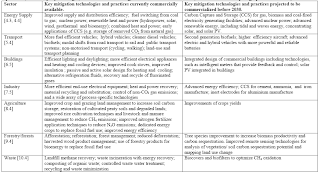
And from these the report comes up with the following sectoral estimates of economic potential for global mitigation by 2030.

This table shows that the building sector has the largest economic potential for mitigation of GHG emissions. However, the sectors studied used different baselines!!! So, what I would take from this is that carbon taxation isn't necessarily a very effective way of reducing emissions in most sectors.
What will this cost?
According to the report, reaching GHG emissions consistent with stabilising concentrations of GHG in the atmosphere to between 445 and 710 ppm (parts per million) CO2-eq will cost the global economy up to 3% of world GDP. It further notes that regional costs may vary significantly from global averages (but doesn't provide any data on the differences).

My thoughts:
The level of GHG in the atmosphere in 2005, was 427 ppm CO2-eq against pre-industrial levels of 278 ppm CO2-eq according to the European Environmental Agency website. I think it is a good debating point as to whether 710 ppm CO2-eq constitutes a responsible target for stabilising emissions.
A summary of these reports is presented in the following two tables that estimate the economic mitigation potential for a given level of carbon taxation by 2030. In the previous blog the term economic potential is defined. In the second blog in this series the scenarios A1B and B2 were presented with a graph of projected emissions in 2030 using the scenarios.
Estimates of economic mitigation potential by 2030, using bottom-up studies:

Note that the bottom up analysis anticipates potential mitigation even at a zero carbon tax.
Estimates of economic mitigation potential by 2030, using top-down studies:

The baseline emissions for 2000 were 43 Gigatonnes CO2-equivalent, so against scenario A1B we would need to see mitigation of 25GtCO2-eq/yr and 6GtCO2-eq/yr against scenario B2 to return to year 2000 emissions levels. To achieve this would require an expected carbon tax of $100 in scenario A1B but could potentially be achieved at zero cost in scenario B2. That's assuming that the baseline of year 2000 emissions doesn't lead to climate change.
The report looks at various sectors of the economy and looks at existing and future commercial technologies that could mitigate GHG emissions. Click the table to open in a new window.

And from these the report comes up with the following sectoral estimates of economic potential for global mitigation by 2030.

This table shows that the building sector has the largest economic potential for mitigation of GHG emissions. However, the sectors studied used different baselines!!! So, what I would take from this is that carbon taxation isn't necessarily a very effective way of reducing emissions in most sectors.
What will this cost?
According to the report, reaching GHG emissions consistent with stabilising concentrations of GHG in the atmosphere to between 445 and 710 ppm (parts per million) CO2-eq will cost the global economy up to 3% of world GDP. It further notes that regional costs may vary significantly from global averages (but doesn't provide any data on the differences).

My thoughts:
The level of GHG in the atmosphere in 2005, was 427 ppm CO2-eq against pre-industrial levels of 278 ppm CO2-eq according to the European Environmental Agency website. I think it is a good debating point as to whether 710 ppm CO2-eq constitutes a responsible target for stabilising emissions.
IPCC’s latest report on Climate Change – summary part 3
Mitigation of Greenhouse gas (GHG) in the short and medium term.
The report introduces a number of concepts which I will copy verbatim from the report and add some explanatory notes.
- The concept of “mitigation potential” has been developed to assess the scale of GHG reductions that could be made, relative to emission baselines, for a given level of carbon price (expressed in cost per unit of carbon dioxide equivalent emissions avoided or reduced).
The carbon price referred to is often called a ‘carbon tax’. So, the report is saying that for different rates of carbon tax there will be an associated reduction (or mitigation) of GHG emissions against a no carbon tax situation.
- Market potential is the mitigation potential based on private costs and private discount rates, which might be expected to occur under forecast market conditions, including policies and measures currently in place, noting that barriers limit actual uptake.
This, I think, is saying that companies could be expected to undertake emission reduction if a carbon tax was in place, because projects which were previously uneconomic, for the business, would become so. In other words, companies would eliminate GHG emissions when it was cheaper to do so than pay the carbon tax.
Economic potential looks at the broader costs and savings arising from GHG emissions and their mitigation. For example, the costs of respiratory disease from air pollution. A clean air act, from a narrow perspective might seem to just impose costs on companies to clean up their act. A broader view considers the lost productivity due to worker illness and the health costs picked up by individuals, companies and the state. An even broader view would consider quality of life and attempt to put an economic value on clean air.
As the study notes, the broader perspective of the economic potential is generally greater than the market potential.
To estimate the potential, two broad classes of approach are used:
- Bottom-up studies are based on assessment of mitigation options, emphasizing specific technologies and regulations. They are typically sectoral studies taking the macro-economy as unchanged. Sector estimates have been aggregated … to provide an estimate of global mitigation potential for this assessment.
Bottom-up looks at individual sectors, such as the power industry or transport, and the affect that technology change or regulation could have in reducing emissions. These are then aggregated to produce global estimates.
Over time, these models have become more similar as bits from each approach have been incorporated in the other and the results they produce are quite similar as we’ll see in the next blog.
The report identifies a particular advantage of bottom-up studies which is for the assessment of specific policy options at the sectoral level while top-down studies are useful for assessing cross-sectoral and economy-wide climate change policies, such as carbon taxes and stabilization policies.
One final caution:
- However, current bottom-up and top-down studies of economic potential have limitations in considering life-style choices, and in including all externalities such as local air pollution. They have limited representation of some regions, countries, sectors, gases, and barriers. The projected mitigation costs do not take into account potential benefits of avoided climate change.
I will look at some of the sectoral analysis in the next blog. I have to admit that this taking longer than I expected but I think it is important that the terms in which the report is framed are aired and explained.
IPCC’s latest report on Climate Change – summary part 2
After looking at historical emissions trends, the report then looks at future greenhouse gas (GHG) emissions trends and considers a series of scenarios around economic growth, global population growth, development of new technologies and their uptake. These were developed separately by the Special Report on Emission Scenarios.
The scenarios are:
A1. There is rapid economic growth with global population growth which peaks mid-century declining thereafter. The theme of this scenario is that the regions of the world converge, economically, scoially and culturally, and there is a substantial reduction in regional differences in per capita income.
This splits into 3 groups that describe alternative technological change to energy systems:
A1F1. Fossil fuel intensive.
A1T. Non-fossil energy sources prevalent.
A1B. A balance across a range of energy technologies.
A2. This scenario considers a very heterogeneous world with an emphasis on self-reliance and preservation of local identities. A slow convergence of fertility patterns leads to continuing population growth and technological change is more fragmented and slower than in other scenarios.
B1. Similar to A1 but with rapid changes to economic structures towards a service and information economy, with less material intensity and the introduction of clean and resource efficient technologies. The emphasis is on global solutions to sustainability, including improved equity, but without additional climate initiatives.
B2. Like A2, this scenario describes a world with local solutions to sustainability. It has continuously increasing population growth, at a lower rate than A2, intermediate levels of economic development, and less rapid and more diverse technological changes than the A1 and B1 scenarios.
Estimates of GHG emissions for the years 2030 and 2100 were developed from these scenarios, and have since been updated. Both are included in the graph (and make it a bit confusing!). The year 2000, on the left of the graph, is taken as the baseline.
You can click on the graph to open it in a new window.

The general consensus in the report is that with current climate change mitigation policies and related sustainable development practices, GHG emissions will continue to grow over the next few decades.
As can be seen from the above graph, these scenarios lead to a wide range of projected emissions. These range from an increase of 9.7 Gigatonnes (CO2 equivalent) from the year 2000 baseline by 2030 to 26.7 Gigatonnes (CO2 equivalent) by 2030 - respective a 25% and 90% increase.
By the year 2100, there is a huge variation in GHG emissions between scenarios due to different ways of mitigating them. In the next blog, I'll look at what the report says about mitigating GHG emissions, the sectors where this can be achieved and the costs.
The scenarios are:
A1. There is rapid economic growth with global population growth which peaks mid-century declining thereafter. The theme of this scenario is that the regions of the world converge, economically, scoially and culturally, and there is a substantial reduction in regional differences in per capita income.
This splits into 3 groups that describe alternative technological change to energy systems:
A1F1. Fossil fuel intensive.
A1T. Non-fossil energy sources prevalent.
A1B. A balance across a range of energy technologies.
A2. This scenario considers a very heterogeneous world with an emphasis on self-reliance and preservation of local identities. A slow convergence of fertility patterns leads to continuing population growth and technological change is more fragmented and slower than in other scenarios.
B1. Similar to A1 but with rapid changes to economic structures towards a service and information economy, with less material intensity and the introduction of clean and resource efficient technologies. The emphasis is on global solutions to sustainability, including improved equity, but without additional climate initiatives.
B2. Like A2, this scenario describes a world with local solutions to sustainability. It has continuously increasing population growth, at a lower rate than A2, intermediate levels of economic development, and less rapid and more diverse technological changes than the A1 and B1 scenarios.
Estimates of GHG emissions for the years 2030 and 2100 were developed from these scenarios, and have since been updated. Both are included in the graph (and make it a bit confusing!). The year 2000, on the left of the graph, is taken as the baseline.
You can click on the graph to open it in a new window.

The general consensus in the report is that with current climate change mitigation policies and related sustainable development practices, GHG emissions will continue to grow over the next few decades.
As can be seen from the above graph, these scenarios lead to a wide range of projected emissions. These range from an increase of 9.7 Gigatonnes (CO2 equivalent) from the year 2000 baseline by 2030 to 26.7 Gigatonnes (CO2 equivalent) by 2030 - respective a 25% and 90% increase.
By the year 2100, there is a huge variation in GHG emissions between scenarios due to different ways of mitigating them. In the next blog, I'll look at what the report says about mitigating GHG emissions, the sectors where this can be achieved and the costs.
Friday, 1 June 2007
IPCC latest report – summary part 1
The IPCC’s latest report on climate change is out soon and the summary is available here. The summary looks at:
- Greenhouse gas (GHG) emission trends
- Mitigation in the short and medium term across different economic sectors (until 2030)
- Mitigation in the long term (beyond 2030)
- Policies, measures and instruments to mitigate climate change
- Sustainable development and climate change mitigation
- Gaps in knowledge
If you don’t fancy ploughing through the report and it’s plethora of data and charts, I’ll pull out some highlights over a few blogs. In this one I’ll look at historical trends.
Greenhouse Gas emission trends
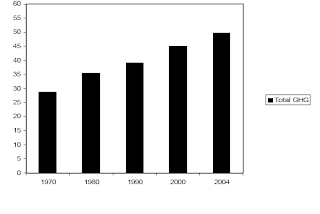
The report starts by looking at greenhouse gas (GHG) emission trends. It notes that between 1970 and 2004 emissions of the main GHGs - CO2, CH4, N2o, HFCs, PFCs and SF6 – have increased by 70% (24% between 1990 and 2004).
The largest growth areas between 1970 and 2004 are the energy supply sector (up 145%) and transport (up 120%). Other areas of note are industry (up 65%), land use, land use change and forestry (up 40%) and agriculture (up 27%).
In 2004, Developed countries produced 57% of world GHG emissions versus 20% of world population.
The long term trend of declining carbon intensity of energy supply reversed after 2000. This means that more carbon is being produced per Watt of energy – and we’re producing a lot more
A range of policies, including those on climate change, energy security, and sustainable development, have been effective in reducing GHG emissions in different sectors and many countries. The scale of such measures, however, has not yet been large enough to counteract the global growth in emissions.
Below is a summary graph of total GHG emissions in Gigatonnes CO2 equivalent from 1970 to 2004.
You can click on the graph to open it in a new window.
Subscribe to:
Posts (Atom)