Clipper Windpower appeared in a recent Daily telegraph Aim Market company profile. Clipper is developing a new offshore wind turbine with a 150m wingspan on a 115m high tower with a generating capacity based around a 7.5 megawatt machine. This is significantly higher than the existing generating capacity of 2.5 megawatts.
California based Clipper Windpower was floated on AIM in 2005 at 200p a share. The price peaked at 916p in June 2007 before two profits warnings drove the price down to below 500p a share in September 2007.
CEO Jim Dehlsen says that the company is working through its supply problems and is ironing out problems with its manufacturing process. The testing phase is expected to start in 2009 or 2010.
Showing posts with label Climate change. Show all posts
Showing posts with label Climate change. Show all posts
Saturday, 22 September 2007


Friday, 17 August 2007
Carbon offset standards
This week's Economist on-line has an article in its Green.view column looking at the baffling array of carbon offset options and registries that have sprouted up over the last year.
The main points are:
The main points are:
- Variable quality of schemes - a tonne of carbon offset can mean many things.
- Growing fears of sharp practice by "carbon cowboys" as prices range from 45c to $45 per tonne of carbon offset.
- Clarity will soon emerge with the highest quality standards surviving, such as the Voluntary Carbon Standard and The Gold Standard developed by the World Wildlife Fund.
- Most of the rest will fall by the wayside.
Wednesday, 15 August 2007
Can Clean Tech save the World from Global Warming?
Let's hope the answer is yes. This week's Red Herring investigates:

Topics covered include:

Topics covered include:
- Ethanol
- Energy efficiency
- Advanced batteries
- AC v DC power distribution
- Solar thermal v Photo-voltaic
- US Energy bill in Congress
Wednesday, 25 July 2007
The cost of the Floods
Evan Davis, the BBC's Economics editor, in his latest blog has estimated the economic costs of the current flooding in the UK and pondered what this would mean economically if this is a precursor to more regular bouts of flooding caused by global warming.
In summary:
In summary:
- Evan estimates the cost at around £5 billion.
- £5 billion represents under 1/2% of GDP. So small in the big picture.
- News stories tend to over-embellish damage done and we tend to over-estimate its economic importance.
- This would be more important if it represented a regular economic cost, say every few years, rather than a one in sixty year event.
- Infrastructure may need to be made more weather-proof at significant expense.
Monday, 23 July 2007
Building on flood plains
The leaked UK housing green paper says that a ban on building on flood plains would be "unrealistic". Against the backdrop of widespread flooding in the UK, which so far has affected around half a million people in England, it seems reckless. In fact, Gordon Brown, in his press briefing today, said that climate change meant planning for more extreme weather events was needed. This planning doesn't appear to stretch to where we should safely build people's houses. The only conclusion I can draw is that Brown & co assume that the political gains from happy new home owners is greater than the risk of widespread flooding before an election.
I could of course be being wildly cynical and, in fact, the government are going to take into account the risk of flooding and build appropriate houses like these in the Netherlands.

The BBC has an article about them here.
Of course, the other issue here is insurance. Will Insurance companies insure new homes built in flood planes? It seems unlikely unless the premiums are very expensive and the flood defences very good. Which, of course, they aren't as the state has failed in its side of the bargain and neglect flood defences for years.
As global warming is likely to increase sea levels over the next few decades, the low lying Thames estuary will become susceptible to flooding. It is also being touted by engineers as probably the best flood defence for Central London, particularly against storm surges from the North Sea. The mooted plans to build hundreds of thousands of homes there seems not just reckless for those who would be living there but also for Londoners and their businesses.
I could of course be being wildly cynical and, in fact, the government are going to take into account the risk of flooding and build appropriate houses like these in the Netherlands.

The BBC has an article about them here.
Of course, the other issue here is insurance. Will Insurance companies insure new homes built in flood planes? It seems unlikely unless the premiums are very expensive and the flood defences very good. Which, of course, they aren't as the state has failed in its side of the bargain and neglect flood defences for years.
As global warming is likely to increase sea levels over the next few decades, the low lying Thames estuary will become susceptible to flooding. It is also being touted by engineers as probably the best flood defence for Central London, particularly against storm surges from the North Sea. The mooted plans to build hundreds of thousands of homes there seems not just reckless for those who would be living there but also for Londoners and their businesses.
Tuesday, 17 July 2007
Developing world more concerned by Global Warming than the Developed World
The economist.com reports that people in China, Brazil, India and Mexico are more concerned about global warming than their counterparts in the Developed world. It also shows a high level of pessimism in the West about our ability (or willingness to make sacrifices?) to fight climate change.
I wonder how much of this is a generational thing. I think young people are far more optimistic about their abilities to make changes, both to their own lifestyles and to society, and are almost certainly less set in their ways than older people. And there is a far higher proportion of young people in Developing countries than in the ageing West.
- 60% of Indians think climate change is one of the world's biggest problems.
- 47% of Chinese agree.
- Only 22% of Britons think so.
- Only 5% of Britons think people and organisations (including governments) were doing enough.
- 41% of Germans thought it was not worth bothering as nothing could be done about climate change.
I wonder how much of this is a generational thing. I think young people are far more optimistic about their abilities to make changes, both to their own lifestyles and to society, and are almost certainly less set in their ways than older people. And there is a far higher proportion of young people in Developing countries than in the ageing West.
Wednesday, 11 July 2007
'No Sun link' to climate change
The following story appeared on the BBC news website reporting that new scientific findings, published in the Royal Society's journal Proceedings A, show no link between the Sun's output and global warming:
http://news.bbc.co.uk/1/hi/sci/tech/6290228.stm
The study was initiated in response to claims made in the Channel 4 documentary 'The Great Global Warming Swindle'.
A thorough debunking of climate change myths can be found on the New Scientist website -
Climate change: A guide for the perplexed
http://news.bbc.co.uk/1/hi/sci/tech/6290228.stm
The study was initiated in response to claims made in the Channel 4 documentary 'The Great Global Warming Swindle'.
A thorough debunking of climate change myths can be found on the New Scientist website -
Climate change: A guide for the perplexed
Monday, 25 June 2007
Airbus A380 SuperJumbo bought as Private Jet
My jaw dropped when I read The Economist that a private buyer has placed an order at the Paris Air Show for an Airbus A380 super-jumbo. Airbus said the individual was "not from Europe or the US" and that the plane was for "personal use for him and his entourage". The cost is estimated at around $300m.
This follows on from Joseph Lau, the Hong Kong Real Estate tycoon, who became the seventh person to order a Boeing 787 VIP as a private jet.
Apart from the moral aspects of such outrageous flaunting of wealth, the unjustifiable squandering of the earth's limited resources mean that neither Boeing nor Airbus should even be selling large aircraft for this purpose. But as all taste and propriety seems to have disappeared in the stratosphere of the super-rich and the boardrooms of corporate behemoths, then a simpler approach needs to be taken.
My proposition is this, that non-commercial/private aircraft, over a certain (small) size, should be barred from landing at any public airport or airport whose flight path causes noise pollution over residential areas. And that should go double in the over-crowded skies in Europe and the US.
This follows on from Joseph Lau, the Hong Kong Real Estate tycoon, who became the seventh person to order a Boeing 787 VIP as a private jet.
Apart from the moral aspects of such outrageous flaunting of wealth, the unjustifiable squandering of the earth's limited resources mean that neither Boeing nor Airbus should even be selling large aircraft for this purpose. But as all taste and propriety seems to have disappeared in the stratosphere of the super-rich and the boardrooms of corporate behemoths, then a simpler approach needs to be taken.
My proposition is this, that non-commercial/private aircraft, over a certain (small) size, should be barred from landing at any public airport or airport whose flight path causes noise pollution over residential areas. And that should go double in the over-crowded skies in Europe and the US.
Monday, 18 June 2007
EU greenhouse gas emissions drop
The European Environmental Agency's "Annual European Community greenhouse gas inventory 1990-2005 and inventory report 2007" reports that emissions of greenhouses gases (GHGs) dropped between 2004 and 2005, the latest years for which they have figures. The key findings are:

- EU-15: Emissions of GHGs decreased by 0.8 % between 2004 and 2005.
- EU-27: Emissions of GHGs decreased by 0.7 % between 2004 and 2005.
- EU-15: Emissions of GHGs decreased by 2 % compared to 1990.
- EU-27: Emissions of GHGs decreased by 7.9 % compared to 1990 levels.
- Germany, Finland and the Netherlands contributed most to the EU-15 reduction.

Tuesday, 5 June 2007
Emissions accelerating faster than economy
The US National Academy of Sciences have just produced a report which finds that global greenhouse gas emissions have since 2000 been growing more quickly than the global economy. This is faster than the worst predictions of the Inter-governmental Panel on Climate Change (IPCC).
Here is the summary text with graph:
"Carbon dioxide released to the atmosphere is the main culprit in human-induced global warming. Typically, developed countries are identified as the main source of CO2 as a result of the burning of fossil fuels and other industrialized processes. An analysis by Michael Raupach et al. shows that developing countries are quickly catching up in CO2 emissions. The authors studied regional trends in emissions, energy use, and population and economic growth to determine patterns that affect CO2 emission and, ultimately, global warming. The analysis showed that, since 2000, CO2 emissions worldwide have increased more rapidly than predicted because emissions and energy use are growing faster than the gross domestic product (GDP) of many countries. No countries are decreasing their percentage of reliance on fossil carbon as an energy source. In addition, developing countries show significantly increased recent rates of growth in emissions. Developing economies, together forming 80% of the world's population, accounted for 73% of the global growth in emissions in 2004. However, these economies accounted for only 41% of emissions themselves and only 23% of emissions since the start of the Industrial Revolution around 1800."

Here is the summary text with graph:
"Carbon dioxide released to the atmosphere is the main culprit in human-induced global warming. Typically, developed countries are identified as the main source of CO2 as a result of the burning of fossil fuels and other industrialized processes. An analysis by Michael Raupach et al. shows that developing countries are quickly catching up in CO2 emissions. The authors studied regional trends in emissions, energy use, and population and economic growth to determine patterns that affect CO2 emission and, ultimately, global warming. The analysis showed that, since 2000, CO2 emissions worldwide have increased more rapidly than predicted because emissions and energy use are growing faster than the gross domestic product (GDP) of many countries. No countries are decreasing their percentage of reliance on fossil carbon as an energy source. In addition, developing countries show significantly increased recent rates of growth in emissions. Developing economies, together forming 80% of the world's population, accounted for 73% of the global growth in emissions in 2004. However, these economies accounted for only 41% of emissions themselves and only 23% of emissions since the start of the Industrial Revolution around 1800."

Monday, 4 June 2007
George Bush and Climate Change
So, straight to the $64,000 question: is George Bush serious about addressing climate change or is he trying to derail European efforts to address it?
His previous record suggests great scepticism is due him. As the latest report from the IPCC has laid out in great detail, there are serious time constraints on us to achieve stabilisation of greenhouse gas (GHG) concentrations in the atmosphere. If we fail to achieve this then the likelihood of severe climate change impacts is increased.
This is from Chapter 3 of the latest IPCC report:
"Decisions to delay emission reductions seriously constrain opportunities to achieve low stabilisation targets (e.g. stabilising concentrations from 440 to 535 ppmv CO2-eq), and raise the risk of progressively more severe climate change impacts and key vulnerabilities occurring. For example, if the time when global emissions peak is postponed beyond the next 15 years category, constraining global temperature rise to below 2.6°C above the pre-industrial level (2.0°C above 1990), at equilibrium, would be out of reach using 'best estimate' assumptions of climate sensitivity. Once this temperature threshold is breached, climate impacts accrue significantly in the earth and human system."
As I pointed out in this blog on the latest IPCC report - "Delayed emissions reduction lead to investments that lock in more emissions-intensive infrastructure and this constrains the opportunities to achieve lower stabilisation levels and increases the risk of more severe climate change impacts." So, time is critical in addresing climate change and GHG emissions.
The European Union has agreed to a goal of preventing a temperature rise of more than 2C and to that end is promising to cut GHG emissions by 20% by 2020 (and by 50% by 2050). Some member states, including the UK are proposing to go further.
George Bush seems intent on refusing to commit to carbon reduction goals or timeframes. Instead he seems to be pinning his hope on technology to bail us out. But by ruling out carbon trading and refusing to accept a carbon tax this is unlikely to happen because for technology to be cost effective there needs to be a realistic carbon price (against which the technology can save money). This is at odds with the wishes of many of the states, including California, which want carbon trading systems and with much of US business which would like to operate under one set of rules.
So, the likelihood is that George Bush will seek to play for time, by insisting that China and India have to sign up for emissions cuts before the US will, and push the whole issue onto the next President in 2009.
His previous record suggests great scepticism is due him. As the latest report from the IPCC has laid out in great detail, there are serious time constraints on us to achieve stabilisation of greenhouse gas (GHG) concentrations in the atmosphere. If we fail to achieve this then the likelihood of severe climate change impacts is increased.
This is from Chapter 3 of the latest IPCC report:
"Decisions to delay emission reductions seriously constrain opportunities to achieve low stabilisation targets (e.g. stabilising concentrations from 440 to 535 ppmv CO2-eq), and raise the risk of progressively more severe climate change impacts and key vulnerabilities occurring. For example, if the time when global emissions peak is postponed beyond the next 15 years category, constraining global temperature rise to below 2.6°C above the pre-industrial level (2.0°C above 1990), at equilibrium, would be out of reach using 'best estimate' assumptions of climate sensitivity. Once this temperature threshold is breached, climate impacts accrue significantly in the earth and human system."
As I pointed out in this blog on the latest IPCC report - "Delayed emissions reduction lead to investments that lock in more emissions-intensive infrastructure and this constrains the opportunities to achieve lower stabilisation levels and increases the risk of more severe climate change impacts." So, time is critical in addresing climate change and GHG emissions.
The European Union has agreed to a goal of preventing a temperature rise of more than 2C and to that end is promising to cut GHG emissions by 20% by 2020 (and by 50% by 2050). Some member states, including the UK are proposing to go further.
George Bush seems intent on refusing to commit to carbon reduction goals or timeframes. Instead he seems to be pinning his hope on technology to bail us out. But by ruling out carbon trading and refusing to accept a carbon tax this is unlikely to happen because for technology to be cost effective there needs to be a realistic carbon price (against which the technology can save money). This is at odds with the wishes of many of the states, including California, which want carbon trading systems and with much of US business which would like to operate under one set of rules.
So, the likelihood is that George Bush will seek to play for time, by insisting that China and India have to sign up for emissions cuts before the US will, and push the whole issue onto the next President in 2009.
Sunday, 3 June 2007
IPCC’s latest report on Climate Change – summary part 7
In this final part, I’ll look at the role of government intervention and at sustainable development.
The case for government intervention
Government support through financial contributions, tax credits, standard setting and market creation is important for effective technology development, innovation and deployment.
- Public benefits of R&D investments are bigger than the benefits captured by the private sector, justifying government support of R&D.
- Government funding in real absolute terms for most energy research programmes has been flat or declining for nearly two decades and is now about half of the 1980 level.
- Governments have a crucial supportive role in providing an appropriate enabling environment to sustain investment flows and for effective technology transfer - without which it may be difficult to achieve emission reductions at a significant scale.
Even for an economic liberal like myself, there is a clear role for the state in setting the stage for tackling carbon emissions. I think it is clear that a carbon price needs to be set that reflects the damage caused by CO2 emissions. That way, it can be established what alternate energy sources, such as renewables and nuclear are viable. Also, it will cut out marginal economic activity that is only profitable when carbon emissions are ‘free’ to the polluter. Although I’m generally against tax breaks, in this case I think they are necessary to push the market to investing in speculative, energy efficient technologies, so that they can be brought to market quicker and make an impact on CO2 emissions sooner. As mentioned in the previous blog, the sooner the peak in emissions is reached and the decline starts, the sooner we will reach CO2 stabilisation and lower the rise in global temperatures will be.
Sustainable development
Making development more sustainable can make a major contribution to climate change mitigation whilst also providing other beneficial effects. For example:
- Climate change policies related to energy efficiency and renewable energy are often economically beneficial, improve energy security and reduce local pollutant emissions.
- Other energy supply mitigation options can be designed to also achieve sustainable development benefits such as avoided displacement of local populations, job creation, and health benefits.
- Reducing both loss of natural habitat and deforestation can have significant biodiversity, soil and water conservation benefits, and can be implemented in a socially and economically sustainable manner.
- Forestation and bioenergy plantations can lead to restoration of degraded land, manage water runoff, retain soil carbon and benefit rural economies.
One final point is the importance of the transfer of energy efficient technologies to developing countries. This will require the help of developed countries’ governments to overcome barriers to implementation, such as lack of skills and financing. A simple example of this would be transferring and implementing carbon sequestration technologies in developing countries that use a lot of coal fired power stations, such as China. The benefit in mitigation terms would be huge.
The case for government intervention
Government support through financial contributions, tax credits, standard setting and market creation is important for effective technology development, innovation and deployment.
- Public benefits of R&D investments are bigger than the benefits captured by the private sector, justifying government support of R&D.
- Government funding in real absolute terms for most energy research programmes has been flat or declining for nearly two decades and is now about half of the 1980 level.
- Governments have a crucial supportive role in providing an appropriate enabling environment to sustain investment flows and for effective technology transfer - without which it may be difficult to achieve emission reductions at a significant scale.
Even for an economic liberal like myself, there is a clear role for the state in setting the stage for tackling carbon emissions. I think it is clear that a carbon price needs to be set that reflects the damage caused by CO2 emissions. That way, it can be established what alternate energy sources, such as renewables and nuclear are viable. Also, it will cut out marginal economic activity that is only profitable when carbon emissions are ‘free’ to the polluter. Although I’m generally against tax breaks, in this case I think they are necessary to push the market to investing in speculative, energy efficient technologies, so that they can be brought to market quicker and make an impact on CO2 emissions sooner. As mentioned in the previous blog, the sooner the peak in emissions is reached and the decline starts, the sooner we will reach CO2 stabilisation and lower the rise in global temperatures will be.
Sustainable development
Making development more sustainable can make a major contribution to climate change mitigation whilst also providing other beneficial effects. For example:
- Climate change policies related to energy efficiency and renewable energy are often economically beneficial, improve energy security and reduce local pollutant emissions.
- Other energy supply mitigation options can be designed to also achieve sustainable development benefits such as avoided displacement of local populations, job creation, and health benefits.
- Reducing both loss of natural habitat and deforestation can have significant biodiversity, soil and water conservation benefits, and can be implemented in a socially and economically sustainable manner.
- Forestation and bioenergy plantations can lead to restoration of degraded land, manage water runoff, retain soil carbon and benefit rural economies.
One final point is the importance of the transfer of energy efficient technologies to developing countries. This will require the help of developed countries’ governments to overcome barriers to implementation, such as lack of skills and financing. A simple example of this would be transferring and implementing carbon sequestration technologies in developing countries that use a lot of coal fired power stations, such as China. The benefit in mitigation terms would be huge.
IPCC’s latest report on Climate Change – summary part 6
Mitigation in the long term (after 2030).
The report starts by making the fairly obvious point that to stabilise the levels of CO2 concentration in the atmosphere, emissions would need to peak and then decline and the lower the stabilisation level, the more quickly this peak and decline would need to occur. So, mitigation efforts over the next two to three decades will be very important. Delayed emissions reduction lead to investments that lock in more emissions-intensive infrastructure and this constrains the opportunities to achieve lower stabilisation levels and increases the risk of more severe climate change impacts.
I think this is a critical point and is why we have to involve developed and developing countries in the process now. We'll come to sustainable development in the next and final part!
Policies, measures and instruments to mitigate climate change
A wide variety of policy instruments are available to governments to create incentives for mitigation action:
- Integrating climate policies in broader development policies.
- Regulations and standards provide some certainty about emission levels.
- Taxes and charges or tradable permits will establish a carbon price.
- Financial incentives (subsidies and tax credits) can be used to stimulate the development and diffusion of new technologies.
- Information instruments (e.g. awareness campaigns) may positively affect environmental quality by promoting informed choices and possibly contributing to behavioural change.
- R&D can stimulate technological advances, reduce costs, and enable progress toward stabilization.
Policies that provide a real or implicit carbon price encourage businesses and consumers to invest in low-GHG alternatives and the report says this provides significant mitigation potential in all sectors. Modelling studies show that with a carbon price, by 2030, in the US$20-80 per tonne CO2-eq range could lead to stabilisation at around 550 ppm CO2-eq by the end of the Century. This equates to a global temperature rise, from pre-industrial levels, of around 3C.
My thoughts on this are that we are currently underestimating the cost of mitigating CO2 emissions. Some of the carbon offset plans charge at less than US$10 per tonne of CO2. This seems implausible to me and suggests that to gain customers some companies are seeking to offer the lowest price to assuage your guilt. I plan to look at carbon offset plans in more detail in the future.
I think what I like about the report in the mitigation area, is that it provides practical steps over the long term that could lead to stabilization levels that whilst bad could be recovered from. In addition, it also stresses the need to act now, and globally, to keep the stabilisation level as low as possible. Most people now accept that global warming exists, so governments need to act. In the last part of this series, I'll look at the role of government and sustainable development.
The report starts by making the fairly obvious point that to stabilise the levels of CO2 concentration in the atmosphere, emissions would need to peak and then decline and the lower the stabilisation level, the more quickly this peak and decline would need to occur. So, mitigation efforts over the next two to three decades will be very important. Delayed emissions reduction lead to investments that lock in more emissions-intensive infrastructure and this constrains the opportunities to achieve lower stabilisation levels and increases the risk of more severe climate change impacts.
I think this is a critical point and is why we have to involve developed and developing countries in the process now. We'll come to sustainable development in the next and final part!
Policies, measures and instruments to mitigate climate change
A wide variety of policy instruments are available to governments to create incentives for mitigation action:
- Integrating climate policies in broader development policies.
- Regulations and standards provide some certainty about emission levels.
- Taxes and charges or tradable permits will establish a carbon price.
- Financial incentives (subsidies and tax credits) can be used to stimulate the development and diffusion of new technologies.
- Information instruments (e.g. awareness campaigns) may positively affect environmental quality by promoting informed choices and possibly contributing to behavioural change.
- R&D can stimulate technological advances, reduce costs, and enable progress toward stabilization.
Policies that provide a real or implicit carbon price encourage businesses and consumers to invest in low-GHG alternatives and the report says this provides significant mitigation potential in all sectors. Modelling studies show that with a carbon price, by 2030, in the US$20-80 per tonne CO2-eq range could lead to stabilisation at around 550 ppm CO2-eq by the end of the Century. This equates to a global temperature rise, from pre-industrial levels, of around 3C.
My thoughts on this are that we are currently underestimating the cost of mitigating CO2 emissions. Some of the carbon offset plans charge at less than US$10 per tonne of CO2. This seems implausible to me and suggests that to gain customers some companies are seeking to offer the lowest price to assuage your guilt. I plan to look at carbon offset plans in more detail in the future.
I think what I like about the report in the mitigation area, is that it provides practical steps over the long term that could lead to stabilization levels that whilst bad could be recovered from. In addition, it also stresses the need to act now, and globally, to keep the stabilisation level as low as possible. Most people now accept that global warming exists, so governments need to act. In the last part of this series, I'll look at the role of government and sustainable development.
Saturday, 2 June 2007
IPCC’s latest report on Climate Change – summary part 5
The report looks at sectors where mitigation of greenhouse gases (GHG) can occur and some examples.
Changes in lifestyle and behaviour patterns (all sectors)
- Changes in lifestyle such as BBC Newsnight's Ethical Man.
- Choices in energy use in buildings such as energy efficient bulbs.
- Improved public transport and reduced car usage.
New energy infrastructure in developing countries and upgrades in industrialised countries
- Investment over US$20 trillion between now and 2030. Long term impact on GHG emissions due to long life of energy plants.
- More effective to invest in end-use energy efficiency improvements than in supply.
- Renewables generally have a positive effect on energy security employment and air quality.
- Carbon sequestration.
To me this is the most interesting area in the whole energy debate and very pertinent given the decision by the UK government to go down the nuclear road again whilst China, and other developing countries, are building a vast coal fired energy infrastructure (we'd better hope that carbon sequestration is a goer!). Energy security in Western Europe is a huge issue with Russia an increasingly unreliable and menacing supplier. In my opinion pushing renewables is a no-brainer for developed countries and is an area that I have been investing in.
Transport sector - mitigation v growth
- Improved vehicle efficency. (Will only happen IMO if oil prices stay high).
- Biofuels to grow to 3% of market by 2030 possibly as high of 5-10% depending on oil price and level of carbon tax.
- Shift from road to public transport. (I just can't see this happening).
- Improvements in fuel efficiency and traffic management in aviation industry (versus high growth).
More energy efficiency options for new and existing buildings
- About 30% of GHG emissions could be avoided in this sector by 2030.
Industrial sector - energy intensive industries
- Upgrading old, inefficient facilities would significantly reduce emissions. Slow rate of capital stock turnover particularly in small and medium sized enterprises is a key barrier.
Agriculture - significant contribution at a low cost
- Soil carbon sequestration.
- Reductions in methane and nitrous oxide emissions in some agricultural systems.
Forestry - carbon sinks at low cost
- About 65% of the total mitigation potential is located in the tropics and about half could be achieved by reducing emissions from deforesting.
Household waste - small contributor but low cost mitigation
- Wide range of mature, effective technologies available.
- Waste minimisation and recycling mitigate through conservation of energy and materials.
Speculative - geo engineering projects
- Ocean fertilisation to remove CO2 from the atmosphere.
- Blocking the sun in the upper atmosphere. (Or pie in the sky?)
Unproven, costly and with the risk of unforseen side-effects.
The problem of global warming can seem overwhelming at times and the benefit of taking a sector by sector approach is that it becomes apparent that with the political will in all nations we can overcome this problem with a myriad of initiatives across the whole spectrum of human activities. I would recommend Elizabeth Kolbert's 'Field Notes from a Catastrophe' which looks at this in more detail.
Changes in lifestyle and behaviour patterns (all sectors)
- Changes in lifestyle such as BBC Newsnight's Ethical Man.
- Choices in energy use in buildings such as energy efficient bulbs.
- Improved public transport and reduced car usage.
New energy infrastructure in developing countries and upgrades in industrialised countries
- Investment over US$20 trillion between now and 2030. Long term impact on GHG emissions due to long life of energy plants.
- More effective to invest in end-use energy efficiency improvements than in supply.
- Renewables generally have a positive effect on energy security employment and air quality.
- Carbon sequestration.
To me this is the most interesting area in the whole energy debate and very pertinent given the decision by the UK government to go down the nuclear road again whilst China, and other developing countries, are building a vast coal fired energy infrastructure (we'd better hope that carbon sequestration is a goer!). Energy security in Western Europe is a huge issue with Russia an increasingly unreliable and menacing supplier. In my opinion pushing renewables is a no-brainer for developed countries and is an area that I have been investing in.
Transport sector - mitigation v growth
- Improved vehicle efficency. (Will only happen IMO if oil prices stay high).
- Biofuels to grow to 3% of market by 2030 possibly as high of 5-10% depending on oil price and level of carbon tax.
- Shift from road to public transport. (I just can't see this happening).
- Improvements in fuel efficiency and traffic management in aviation industry (versus high growth).
More energy efficiency options for new and existing buildings
- About 30% of GHG emissions could be avoided in this sector by 2030.
Industrial sector - energy intensive industries
- Upgrading old, inefficient facilities would significantly reduce emissions. Slow rate of capital stock turnover particularly in small and medium sized enterprises is a key barrier.
Agriculture - significant contribution at a low cost
- Soil carbon sequestration.
- Reductions in methane and nitrous oxide emissions in some agricultural systems.
Forestry - carbon sinks at low cost
- About 65% of the total mitigation potential is located in the tropics and about half could be achieved by reducing emissions from deforesting.
Household waste - small contributor but low cost mitigation
- Wide range of mature, effective technologies available.
- Waste minimisation and recycling mitigate through conservation of energy and materials.
Speculative - geo engineering projects
- Ocean fertilisation to remove CO2 from the atmosphere.
- Blocking the sun in the upper atmosphere. (Or pie in the sky?)
Unproven, costly and with the risk of unforseen side-effects.
The problem of global warming can seem overwhelming at times and the benefit of taking a sector by sector approach is that it becomes apparent that with the political will in all nations we can overcome this problem with a myriad of initiatives across the whole spectrum of human activities. I would recommend Elizabeth Kolbert's 'Field Notes from a Catastrophe' which looks at this in more detail.
Carbon trading expansion plan in UK
The Financial Times reports today that a white paper, which is to be published on Wednesday is "expected to commit the UK government to a world-leading emissions trading scheme going far beyond a European Union-wide system and plans by US states." The new scheme could affect up to 5,000 British organisations going beyond the usual big energy users. Ministers are looking at two options, one covering nearly 5,000 organisations consuming 3,000 megawatt hours or to have a higher threshold of 10,000 megawatt hours covering about 1,200 organisations. The scheme will probably be an auction-based cap and trade programme. The FT reports that hospitals, universities, government departments and local authorities could also be included in what ministers have decided should be a mandatory scheme.
The scheme is intended to cut annual carbon emissions by at least 1m tonnes by 2020.
My concern about this 'go it alone' plan is that it will further encourage British companies to look at relocating abroad and discourage inward investment, in effect exporting our pollution to less environmentally friendly countries. This is one area where I think international co-operation, standards and regulations are essential, otherwise companies will be able to arbitrage national regulations and evade their responsibilities.
The scheme is intended to cut annual carbon emissions by at least 1m tonnes by 2020.
My concern about this 'go it alone' plan is that it will further encourage British companies to look at relocating abroad and discourage inward investment, in effect exporting our pollution to less environmentally friendly countries. This is one area where I think international co-operation, standards and regulations are essential, otherwise companies will be able to arbitrage national regulations and evade their responsibilities.
IPCC’s latest report on Climate Change – summary part 4
Following on from yesterday’s blog going through the terms that the report is framed in, today I’ll look at the summary of the studies into greenhouse gas (GHG) mitigation. Both bottom-up and top-down studies indicate that there is substantial economic potential for GHG mitigation over the coming decades that could offset the expected growth in emissions.
A summary of these reports is presented in the following two tables that estimate the economic mitigation potential for a given level of carbon taxation by 2030. In the previous blog the term economic potential is defined. In the second blog in this series the scenarios A1B and B2 were presented with a graph of projected emissions in 2030 using the scenarios.
Estimates of economic mitigation potential by 2030, using bottom-up studies:

Note that the bottom up analysis anticipates potential mitigation even at a zero carbon tax.
Estimates of economic mitigation potential by 2030, using top-down studies:

The baseline emissions for 2000 were 43 Gigatonnes CO2-equivalent, so against scenario A1B we would need to see mitigation of 25GtCO2-eq/yr and 6GtCO2-eq/yr against scenario B2 to return to year 2000 emissions levels. To achieve this would require an expected carbon tax of $100 in scenario A1B but could potentially be achieved at zero cost in scenario B2. That's assuming that the baseline of year 2000 emissions doesn't lead to climate change.
The report looks at various sectors of the economy and looks at existing and future commercial technologies that could mitigate GHG emissions. Click the table to open in a new window.
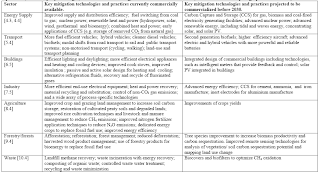
And from these the report comes up with the following sectoral estimates of economic potential for global mitigation by 2030.

This table shows that the building sector has the largest economic potential for mitigation of GHG emissions. However, the sectors studied used different baselines!!! So, what I would take from this is that carbon taxation isn't necessarily a very effective way of reducing emissions in most sectors.
What will this cost?
According to the report, reaching GHG emissions consistent with stabilising concentrations of GHG in the atmosphere to between 445 and 710 ppm (parts per million) CO2-eq will cost the global economy up to 3% of world GDP. It further notes that regional costs may vary significantly from global averages (but doesn't provide any data on the differences).

My thoughts:
The level of GHG in the atmosphere in 2005, was 427 ppm CO2-eq against pre-industrial levels of 278 ppm CO2-eq according to the European Environmental Agency website. I think it is a good debating point as to whether 710 ppm CO2-eq constitutes a responsible target for stabilising emissions.
A summary of these reports is presented in the following two tables that estimate the economic mitigation potential for a given level of carbon taxation by 2030. In the previous blog the term economic potential is defined. In the second blog in this series the scenarios A1B and B2 were presented with a graph of projected emissions in 2030 using the scenarios.
Estimates of economic mitigation potential by 2030, using bottom-up studies:

Note that the bottom up analysis anticipates potential mitigation even at a zero carbon tax.
Estimates of economic mitigation potential by 2030, using top-down studies:

The baseline emissions for 2000 were 43 Gigatonnes CO2-equivalent, so against scenario A1B we would need to see mitigation of 25GtCO2-eq/yr and 6GtCO2-eq/yr against scenario B2 to return to year 2000 emissions levels. To achieve this would require an expected carbon tax of $100 in scenario A1B but could potentially be achieved at zero cost in scenario B2. That's assuming that the baseline of year 2000 emissions doesn't lead to climate change.
The report looks at various sectors of the economy and looks at existing and future commercial technologies that could mitigate GHG emissions. Click the table to open in a new window.

And from these the report comes up with the following sectoral estimates of economic potential for global mitigation by 2030.

This table shows that the building sector has the largest economic potential for mitigation of GHG emissions. However, the sectors studied used different baselines!!! So, what I would take from this is that carbon taxation isn't necessarily a very effective way of reducing emissions in most sectors.
What will this cost?
According to the report, reaching GHG emissions consistent with stabilising concentrations of GHG in the atmosphere to between 445 and 710 ppm (parts per million) CO2-eq will cost the global economy up to 3% of world GDP. It further notes that regional costs may vary significantly from global averages (but doesn't provide any data on the differences).

My thoughts:
The level of GHG in the atmosphere in 2005, was 427 ppm CO2-eq against pre-industrial levels of 278 ppm CO2-eq according to the European Environmental Agency website. I think it is a good debating point as to whether 710 ppm CO2-eq constitutes a responsible target for stabilising emissions.
IPCC’s latest report on Climate Change – summary part 3
Mitigation of Greenhouse gas (GHG) in the short and medium term.
The report introduces a number of concepts which I will copy verbatim from the report and add some explanatory notes.
- The concept of “mitigation potential” has been developed to assess the scale of GHG reductions that could be made, relative to emission baselines, for a given level of carbon price (expressed in cost per unit of carbon dioxide equivalent emissions avoided or reduced).
The carbon price referred to is often called a ‘carbon tax’. So, the report is saying that for different rates of carbon tax there will be an associated reduction (or mitigation) of GHG emissions against a no carbon tax situation.
- Market potential is the mitigation potential based on private costs and private discount rates, which might be expected to occur under forecast market conditions, including policies and measures currently in place, noting that barriers limit actual uptake.
This, I think, is saying that companies could be expected to undertake emission reduction if a carbon tax was in place, because projects which were previously uneconomic, for the business, would become so. In other words, companies would eliminate GHG emissions when it was cheaper to do so than pay the carbon tax.
Economic potential looks at the broader costs and savings arising from GHG emissions and their mitigation. For example, the costs of respiratory disease from air pollution. A clean air act, from a narrow perspective might seem to just impose costs on companies to clean up their act. A broader view considers the lost productivity due to worker illness and the health costs picked up by individuals, companies and the state. An even broader view would consider quality of life and attempt to put an economic value on clean air.
As the study notes, the broader perspective of the economic potential is generally greater than the market potential.
To estimate the potential, two broad classes of approach are used:
- Bottom-up studies are based on assessment of mitigation options, emphasizing specific technologies and regulations. They are typically sectoral studies taking the macro-economy as unchanged. Sector estimates have been aggregated … to provide an estimate of global mitigation potential for this assessment.
Bottom-up looks at individual sectors, such as the power industry or transport, and the affect that technology change or regulation could have in reducing emissions. These are then aggregated to produce global estimates.
Over time, these models have become more similar as bits from each approach have been incorporated in the other and the results they produce are quite similar as we’ll see in the next blog.
The report identifies a particular advantage of bottom-up studies which is for the assessment of specific policy options at the sectoral level while top-down studies are useful for assessing cross-sectoral and economy-wide climate change policies, such as carbon taxes and stabilization policies.
One final caution:
- However, current bottom-up and top-down studies of economic potential have limitations in considering life-style choices, and in including all externalities such as local air pollution. They have limited representation of some regions, countries, sectors, gases, and barriers. The projected mitigation costs do not take into account potential benefits of avoided climate change.
I will look at some of the sectoral analysis in the next blog. I have to admit that this taking longer than I expected but I think it is important that the terms in which the report is framed are aired and explained.
IPCC’s latest report on Climate Change – summary part 2
After looking at historical emissions trends, the report then looks at future greenhouse gas (GHG) emissions trends and considers a series of scenarios around economic growth, global population growth, development of new technologies and their uptake. These were developed separately by the Special Report on Emission Scenarios.
The scenarios are:
A1. There is rapid economic growth with global population growth which peaks mid-century declining thereafter. The theme of this scenario is that the regions of the world converge, economically, scoially and culturally, and there is a substantial reduction in regional differences in per capita income.
This splits into 3 groups that describe alternative technological change to energy systems:
A1F1. Fossil fuel intensive.
A1T. Non-fossil energy sources prevalent.
A1B. A balance across a range of energy technologies.
A2. This scenario considers a very heterogeneous world with an emphasis on self-reliance and preservation of local identities. A slow convergence of fertility patterns leads to continuing population growth and technological change is more fragmented and slower than in other scenarios.
B1. Similar to A1 but with rapid changes to economic structures towards a service and information economy, with less material intensity and the introduction of clean and resource efficient technologies. The emphasis is on global solutions to sustainability, including improved equity, but without additional climate initiatives.
B2. Like A2, this scenario describes a world with local solutions to sustainability. It has continuously increasing population growth, at a lower rate than A2, intermediate levels of economic development, and less rapid and more diverse technological changes than the A1 and B1 scenarios.
Estimates of GHG emissions for the years 2030 and 2100 were developed from these scenarios, and have since been updated. Both are included in the graph (and make it a bit confusing!). The year 2000, on the left of the graph, is taken as the baseline.
You can click on the graph to open it in a new window.

The general consensus in the report is that with current climate change mitigation policies and related sustainable development practices, GHG emissions will continue to grow over the next few decades.
As can be seen from the above graph, these scenarios lead to a wide range of projected emissions. These range from an increase of 9.7 Gigatonnes (CO2 equivalent) from the year 2000 baseline by 2030 to 26.7 Gigatonnes (CO2 equivalent) by 2030 - respective a 25% and 90% increase.
By the year 2100, there is a huge variation in GHG emissions between scenarios due to different ways of mitigating them. In the next blog, I'll look at what the report says about mitigating GHG emissions, the sectors where this can be achieved and the costs.
The scenarios are:
A1. There is rapid economic growth with global population growth which peaks mid-century declining thereafter. The theme of this scenario is that the regions of the world converge, economically, scoially and culturally, and there is a substantial reduction in regional differences in per capita income.
This splits into 3 groups that describe alternative technological change to energy systems:
A1F1. Fossil fuel intensive.
A1T. Non-fossil energy sources prevalent.
A1B. A balance across a range of energy technologies.
A2. This scenario considers a very heterogeneous world with an emphasis on self-reliance and preservation of local identities. A slow convergence of fertility patterns leads to continuing population growth and technological change is more fragmented and slower than in other scenarios.
B1. Similar to A1 but with rapid changes to economic structures towards a service and information economy, with less material intensity and the introduction of clean and resource efficient technologies. The emphasis is on global solutions to sustainability, including improved equity, but without additional climate initiatives.
B2. Like A2, this scenario describes a world with local solutions to sustainability. It has continuously increasing population growth, at a lower rate than A2, intermediate levels of economic development, and less rapid and more diverse technological changes than the A1 and B1 scenarios.
Estimates of GHG emissions for the years 2030 and 2100 were developed from these scenarios, and have since been updated. Both are included in the graph (and make it a bit confusing!). The year 2000, on the left of the graph, is taken as the baseline.
You can click on the graph to open it in a new window.

The general consensus in the report is that with current climate change mitigation policies and related sustainable development practices, GHG emissions will continue to grow over the next few decades.
As can be seen from the above graph, these scenarios lead to a wide range of projected emissions. These range from an increase of 9.7 Gigatonnes (CO2 equivalent) from the year 2000 baseline by 2030 to 26.7 Gigatonnes (CO2 equivalent) by 2030 - respective a 25% and 90% increase.
By the year 2100, there is a huge variation in GHG emissions between scenarios due to different ways of mitigating them. In the next blog, I'll look at what the report says about mitigating GHG emissions, the sectors where this can be achieved and the costs.
Friday, 1 June 2007
IPCC latest report – summary part 1
The IPCC’s latest report on climate change is out soon and the summary is available here. The summary looks at:
- Greenhouse gas (GHG) emission trends
- Mitigation in the short and medium term across different economic sectors (until 2030)
- Mitigation in the long term (beyond 2030)
- Policies, measures and instruments to mitigate climate change
- Sustainable development and climate change mitigation
- Gaps in knowledge
If you don’t fancy ploughing through the report and it’s plethora of data and charts, I’ll pull out some highlights over a few blogs. In this one I’ll look at historical trends.
Greenhouse Gas emission trends
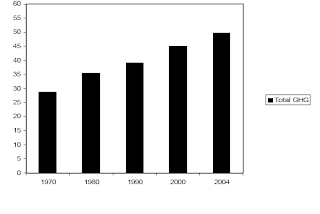
The report starts by looking at greenhouse gas (GHG) emission trends. It notes that between 1970 and 2004 emissions of the main GHGs - CO2, CH4, N2o, HFCs, PFCs and SF6 – have increased by 70% (24% between 1990 and 2004).
The largest growth areas between 1970 and 2004 are the energy supply sector (up 145%) and transport (up 120%). Other areas of note are industry (up 65%), land use, land use change and forestry (up 40%) and agriculture (up 27%).
In 2004, Developed countries produced 57% of world GHG emissions versus 20% of world population.
The long term trend of declining carbon intensity of energy supply reversed after 2000. This means that more carbon is being produced per Watt of energy – and we’re producing a lot more
A range of policies, including those on climate change, energy security, and sustainable development, have been effective in reducing GHG emissions in different sectors and many countries. The scale of such measures, however, has not yet been large enough to counteract the global growth in emissions.
Below is a summary graph of total GHG emissions in Gigatonnes CO2 equivalent from 1970 to 2004.
You can click on the graph to open it in a new window.
Charities' statement on Biofuels
RSPB, WWF, Greenpeace, Oxfam and Friends of the Earth joint statement on biofuels
The group's full statement is:
The current political and business enthusiasm for renewable biofuels is understandable. This emerging industry could play an important role in tackling climate change. However, without appropriate safeguards, this flagship policy could have disastrous unintended consequences - actually increasing carbon emissions, intensifying deforestation and causing extensive negative social impacts.
We are concerned that Government's plans to promote biofuels through the Renewable Transport Fuel Obligation (RTFO), lack these precautions.
Greenhouse gas emissions savings from different biofuels vary widely and some can even result in an overall increase. The RTFO as proposed fails to distinguish between the biofuels that can contribute most to tackling climate change.
In addition, without strong, mandatory standards in place the RTFO will attract biofuels produced at the expense of forests, peat lands and natural grasslands in places such as Brazil and Indonesia. As well as being hugely important habitats, their destruction will add huge volumes of carbon dioxide into the atmosphere. Making biodiesel from soy planted on cleared rainforest takes 200 years before it could be considered carbon neutral.
The expansion of tropical crops such as palm oil is also linked to the loss of indigenous peoples land rights, human rights abuse and the destruction of local communities' natural resources.
To gain our support, the RTFO must:
Although additional measures may become necessary, with these safeguards in place, biofuels are much more likely to contribute to a reduction in emissions from the transport sector without damaging the environment.
We are concerned that Government's plans to promote biofuels through the Renewable Transport Fuel Obligation (RTFO), lack these precautions.
Greenhouse gas emissions savings from different biofuels vary widely and some can even result in an overall increase. The RTFO as proposed fails to distinguish between the biofuels that can contribute most to tackling climate change.
In addition, without strong, mandatory standards in place the RTFO will attract biofuels produced at the expense of forests, peat lands and natural grasslands in places such as Brazil and Indonesia. As well as being hugely important habitats, their destruction will add huge volumes of carbon dioxide into the atmosphere. Making biodiesel from soy planted on cleared rainforest takes 200 years before it could be considered carbon neutral.
The expansion of tropical crops such as palm oil is also linked to the loss of indigenous peoples land rights, human rights abuse and the destruction of local communities' natural resources.
To gain our support, the RTFO must:
- Ensure that biofuels meet strict externally audited, widely accepted and mandatory sustainability and greenhouse gas balance standards, including at least a 50% saving on greenhouse gases compared to fossil fuels, taking a whole life-cycle approach.
- Take account of the greenhouse gases caused by land-use change and forest clearance to grow biofuels so that where high carbon land-uses are lost, no saving is claimed.
Although additional measures may become necessary, with these safeguards in place, biofuels are much more likely to contribute to a reduction in emissions from the transport sector without damaging the environment.
Subscribe to:
Posts (Atom)